
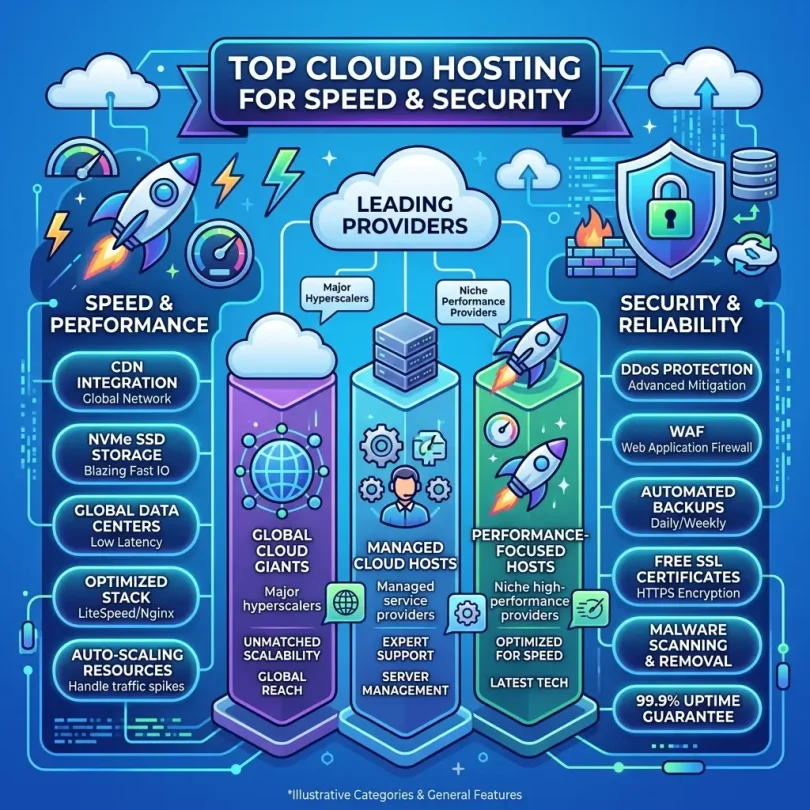

A fast and secure website is no longer optional for a serious business. Whether you run a company website, WordPress blog, ecommerce store, SaaS landing page, online magazine, agency portfolio, membership platform, or lead generation site, your hosting provider directly affects speed, uptime, security, user experience, SEO performance, and revenue.
Slow hosting can increase bounce rate, reduce conversions, frustrate visitors, and make your website feel unprofessional. Weak hosting security can expose your site to malware, brute-force attacks, downtime, data loss, spam injections, or search engine warnings. For businesses that depend on online traffic, hosting is not just a technical decision. It is a business growth decision.
Cloud hosting has become popular because it offers better scalability, stronger infrastructure, easier resource upgrades, improved reliability, and more flexibility than traditional shared hosting. But not every cloud hosting provider is the same. Some are beginner-friendly. Some are built for WordPress. Some are best for developers. Some are best for agencies. Some offer managed cloud hosting, while others require technical server management.
In this guide, we will compare the best cloud hosting providers for fast and secure websites, explain the most important hosting features, and help you choose the right platform based on your website type, traffic level, budget, and technical skill.
Important note: Hosting pricing, renewal rates, server locations, storage limits, bandwidth policies, backup features, security tools, support quality, and plan names can change. Always check the latest details directly on the provider website before purchasing or renewing any hosting plan.
Quick Answer: What Is the Best Cloud Hosting Provider?
The best cloud hosting provider depends on your website needs. Cloudways is a strong option for users who want managed cloud hosting with easier server control. Kinsta and WP Engine are excellent for premium managed WordPress hosting. SiteGround is a good choice for small business websites that want managed features and support. Hostinger Cloud Hosting is attractive for budget-conscious users who want better performance than basic shared hosting. DigitalOcean, Linode, Vultr, AWS, Google Cloud, and Microsoft Azure are powerful choices for developers and technical teams. Liquid Web, Nexcess, and ScalaHosting are useful for managed VPS, ecommerce, and growing business websites.
For most small business websites, the best choice is a managed cloud hosting provider that includes fast servers, SSL, backups, malware protection, CDN support, staging tools, easy scaling, and responsive customer support.
Best Cloud Hosting Providers for Fast and Secure Websites: Comparison Table
| Hosting Provider | Best For | Main Strength | Good Fit For |
|---|---|---|---|
| Cloudways | Managed cloud hosting | Easy cloud server management, performance tools, scalability | WordPress sites, agencies, growing websites |
| Kinsta | Premium managed WordPress hosting | High-performance WordPress hosting, CDN, security, expert support | Business WordPress sites and agencies |
| WP Engine | Enterprise-grade WordPress hosting | Managed WordPress performance, security, staging, support | Brands, publishers, ecommerce and high-value WordPress sites |
| SiteGround | Small business websites | Managed WordPress tools, support, security and speed features | Small businesses, blogs and service sites |
| Hostinger Cloud Hosting | Budget cloud hosting | Affordable cloud plans, easy dashboard, beginner-friendly setup | Startups, blogs, small business websites |
| DigitalOcean | Developers and startups | Cloud VPS droplets, predictable pricing, developer tools | Technical users, SaaS apps and custom projects |
| Linode / Akamai Cloud | Cloud VPS hosting | Developer-friendly cloud infrastructure and global data centers | Developers and technical businesses |
| Vultr | Fast VPS and cloud compute | Flexible cloud servers, high-frequency compute, many locations | Performance-focused developers and agencies |
| Liquid Web | Managed VPS and dedicated hosting | Managed infrastructure, strong support, business hosting | Growing businesses needing managed power |
| Nexcess | Managed ecommerce hosting | WooCommerce, Magento and managed application hosting | Ecommerce stores and online businesses |
| ScalaHosting | Managed cloud VPS | Managed VPS, control panel options, security features | Businesses moving up from shared hosting |
| AWS | Enterprise cloud infrastructure | Scalable cloud services, global infrastructure, advanced controls | Technical teams and large-scale applications |
| Google Cloud | Advanced cloud infrastructure | Cloud compute, networking, data and AI ecosystem | Developers, enterprises and performance-focused teams |
| Microsoft Azure | Microsoft ecosystem cloud | Enterprise cloud, Windows workloads, app hosting and integrations | Businesses using Microsoft technologies |
Why Cloud Hosting Matters for Business Websites
Traditional shared hosting can work for small websites, but it has limits. On shared hosting, multiple websites use the same server resources. If one site consumes too many resources, other sites may slow down. Shared hosting can also offer less control, fewer scaling options, and weaker isolation compared with cloud hosting or VPS hosting.
Cloud hosting usually gives your website access to more scalable infrastructure. Depending on the provider, you may get isolated resources, faster storage, better caching, easier upgrades, global server options, CDN integration, automated backups, staging environments, and stronger security tools.
For a business website, these benefits can make a real difference. Faster pages can improve user experience. Better uptime can protect revenue. Stronger security can reduce risk. Easy scaling can help your site handle traffic spikes from ads, social media, SEO growth, product launches, or seasonal campaigns.
Cloud Hosting vs Shared Hosting vs VPS Hosting
Shared Hosting
Shared hosting is usually the cheapest option. Many websites share the same server. It is beginner-friendly and affordable, but performance can be limited. Shared hosting is best for small personal sites, starter blogs, and low-traffic websites.
VPS Hosting
VPS means virtual private server. It gives your website dedicated virtual resources on a server. VPS hosting usually offers better performance, more control, and stronger isolation than shared hosting. However, unmanaged VPS hosting requires technical knowledge.
Cloud Hosting
Cloud hosting uses cloud infrastructure that can scale resources more flexibly. It may include cloud servers, distributed resources, managed dashboards, CDN integration, load balancing, and advanced security features depending on the provider.
Managed Cloud Hosting
Managed cloud hosting gives you cloud power without requiring you to manage every server detail. The provider usually handles server updates, security patches, monitoring, backups, performance optimization, and support. This is often the best option for small businesses that want speed and reliability without hiring a server administrator.
What to Look for in a Cloud Hosting Provider
1. Website Speed and Performance
Speed is one of the most important hosting factors. A good cloud hosting provider should offer fast servers, modern storage, optimized PHP or runtime versions, server-level caching, CDN support, database optimization, and enough resources for your traffic.
For WordPress websites, performance also depends on theme quality, plugin load, database size, image optimization, caching configuration, and CDN setup. Good hosting helps, but a poorly optimized site can still be slow.
2. Uptime and Reliability
Business websites need reliable uptime. Downtime can mean missed leads, lost sales, broken ads, damaged trust, and lower customer confidence. Look for providers with strong infrastructure, monitoring, redundancy, and clear uptime commitments.
3. Security Features
Hosting security should include SSL certificates, firewalls, malware scanning, DDoS protection, secure access controls, automated updates, backup protection, and server monitoring. WordPress hosting should also support plugin/theme security best practices.
Security is shared responsibility. Your hosting provider protects the infrastructure, but you still need strong passwords, updated software, limited admin access, secure plugins, and regular backups.
4. Automatic Backups
Backups are critical for business websites. A good cloud hosting provider should offer automatic backups, easy restore options, backup retention, and ideally offsite backup storage. Before choosing a host, check whether backups are included or cost extra.
5. CDN Support
A CDN, or content delivery network, helps deliver website files from servers closer to visitors. This can improve speed for global audiences. CDN support is especially useful for websites with international traffic, media-heavy pages, ecommerce stores, and blogs targeting multiple countries.
6. Scalability
Your hosting should scale as your traffic grows. A site may start with a few thousand visits per month and later receive traffic spikes from Google Discover, Facebook, TikTok, paid ads, email campaigns, or viral content. Cloud hosting should make it easier to upgrade CPU, RAM, storage, or bandwidth.
7. Customer Support
Support quality matters when your website is down or slow. Look for 24/7 support, live chat, ticket support, knowledgeable agents, migration help, troubleshooting guidance, and clear documentation. For business websites, cheap hosting with weak support can become expensive during emergencies.
8. Ease of Use
Some cloud platforms are powerful but technical. Others provide easy dashboards for WordPress, SSL, backups, staging, email, domains, and databases. If you are not a developer, choose managed hosting or a beginner-friendly cloud provider.
9. Staging Environment
A staging site lets you test changes before pushing them live. This is important for WordPress updates, theme changes, plugin testing, landing page redesigns, and ecommerce changes. Business websites should avoid making risky changes directly on the live site.
10. Transparent Pricing
Hosting pricing can be tricky. Check monthly cost, renewal rates, storage limits, bandwidth limits, visit limits, overage charges, backup fees, malware removal fees, migration fees, email hosting costs, CDN costs, and support add-ons.
Best Cloud Hosting Providers for Fast and Secure Websites: Detailed Reviews
1. Cloudways
Best for: Managed cloud hosting with flexible server choices
Cloudways is a managed cloud hosting platform that makes cloud infrastructure easier for website owners, agencies, and growing businesses. Instead of directly managing a raw cloud server, users get a dashboard that simplifies application installation, server management, caching, backups, SSL, monitoring, and scaling.
Cloudways is popular with WordPress users, agencies, publishers, ecommerce websites, affiliate sites, and businesses that want better performance than shared hosting without handling every server command manually.
One of the biggest advantages is flexibility. Users can host on cloud infrastructure from providers such as DigitalOcean, AWS, or Google Cloud depending on available options and plan structure. This gives users cloud power with a more beginner-friendly management layer.
Key Features
- Managed cloud hosting dashboard
- WordPress and WooCommerce hosting support
- Server-level caching tools
- Free SSL support
- Automated backups
- Staging environment
- Server monitoring
- Vertical scaling options
- CDN and performance add-ons depending on plan
Pros
- Easier than managing raw cloud servers
- Good balance of performance and control
- Useful for agencies and multiple websites
- Scalable for growing traffic
- Strong fit for WordPress and ecommerce sites
Cons
- Email hosting may require a separate service or add-on
- Some features cost extra
- Still more technical than basic shared hosting
- Support level can depend on plan and add-ons
Best Use Case
Choose Cloudways if you want managed cloud hosting with better speed, scalability, and control than shared hosting, but you do not want to manage a raw VPS yourself.
2. Kinsta
Best for: Premium managed WordPress hosting
Kinsta is a premium managed WordPress hosting provider focused on speed, security, support, and developer-friendly features. It is a strong option for business websites, agencies, publishers, ecommerce stores, membership sites, and high-value WordPress projects.
Kinsta is designed for users who want expert WordPress hosting rather than cheap generic hosting. It usually costs more than beginner hosting providers, but the value comes from managed infrastructure, performance tools, CDN integration, staging, backups, security monitoring, and specialized support.
Key Features
- Managed WordPress hosting
- Cloud-based infrastructure
- CDN integration
- Automatic backups
- Staging environments
- Free SSL support
- Malware and security monitoring features
- Performance monitoring tools
- Developer tools
Pros
- Excellent for serious WordPress sites
- Strong performance focus
- Good dashboard and developer tools
- Helpful for agencies and business websites
- Managed security and support features
Cons
- More expensive than budget hosting
- Focused mainly on WordPress
- Visit and resource limits should be reviewed carefully
- May be more than a small starter blog needs
Best Use Case
Choose Kinsta if your business runs an important WordPress website and wants premium managed hosting with strong performance and expert support.
3. WP Engine
Best for: Managed WordPress hosting for brands and larger sites
WP Engine is another premium managed WordPress hosting provider known for business-focused WordPress hosting, performance, security, staging, developer tools, and support. It is popular among agencies, brands, publishers, ecommerce stores, and companies that need reliable WordPress infrastructure.
WP Engine is not usually the cheapest choice, but it can be valuable for businesses where the website directly supports leads, sales, publishing, brand trust, or customer experience.
Key Features
- Managed WordPress hosting
- Staging and development environments
- Automated backups
- Security monitoring
- Performance caching
- CDN options
- Developer tools
- Agency and enterprise options
Pros
- Strong managed WordPress platform
- Good for agencies and business websites
- Useful staging and development tools
- Security and support features
- Scales better than basic shared hosting
Cons
- Higher cost than entry-level hosting
- Mostly focused on WordPress
- Some plugins or workflows may have restrictions
- Plan limits should be checked carefully
Best Use Case
Choose WP Engine if your business needs reliable managed WordPress hosting for a serious website, agency project, ecommerce store, or content platform.
4. SiteGround
Best for: Small business websites and managed WordPress hosting
SiteGround is a popular hosting provider for small businesses, WordPress users, bloggers, and service websites. It offers managed WordPress features, security tools, caching, support, and beginner-friendly site management.
SiteGround can be a good option for businesses that want better support and managed features than very cheap shared hosting, but do not need a premium enterprise WordPress platform.
Key Features
- Managed WordPress hosting features
- Cloud hosting options
- SSL support
- Daily backups depending on plan
- Caching and speed tools
- Email hosting options
- Security monitoring features
- User-friendly dashboard
Pros
- Good for small business websites
- Beginner-friendly management
- Useful WordPress tools
- Support is a key selling point
- Balanced option between budget and premium hosting
Cons
- Renewal pricing can be higher than introductory pricing
- Resource limits should be reviewed
- Very high-traffic sites may need stronger cloud or VPS plans
- Some advanced features depend on plan
Best Use Case
Choose SiteGround if you run a small business WordPress site and want managed tools, support, security features, and better performance than basic low-cost hosting.
5. Hostinger Cloud Hosting
Best for: Affordable cloud hosting for small websites
Hostinger Cloud Hosting is a budget-friendly option for website owners who want more power than basic shared hosting without paying premium managed WordPress prices. It is popular with startups, blogs, small business sites, affiliate websites, portfolio sites, and beginner website owners.
Hostinger’s main appeal is affordability and ease of use. Its dashboard is beginner-friendly, and cloud hosting plans can provide better resources than traditional entry-level shared hosting.
Key Features
- Cloud hosting plans
- Beginner-friendly dashboard
- WordPress installation tools
- SSL support
- Website migration options
- Backups depending on plan
- Performance and caching tools
- Email and domain options
Pros
- Affordable cloud hosting option
- Easy for beginners
- Good for small business and content sites
- Useful dashboard and website tools
- Better starting point than very basic shared hosting for many users
Cons
- Not as premium as Kinsta or WP Engine
- Support and advanced features vary by plan
- High-traffic business sites may need stronger infrastructure
- Renewal pricing and limits should be checked
Best Use Case
Choose Hostinger Cloud Hosting if you want affordable cloud hosting for a blog, business website, portfolio, affiliate site, or small online project.
6. DigitalOcean
Best for: Developers, startups and custom web applications
DigitalOcean is a cloud infrastructure provider known for developer-friendly cloud servers, called droplets, along with managed databases, Kubernetes, app platform options, storage, networking, and other cloud services.
DigitalOcean is powerful and flexible, but it is best for users who understand server management or have a developer. It can host WordPress, SaaS apps, APIs, custom websites, ecommerce backends, and development projects. However, unmanaged cloud servers require security updates, server configuration, backups, monitoring, and optimization.
Key Features
- Cloud VPS droplets
- Managed databases
- App platform options
- Object storage
- Kubernetes support
- Developer-friendly documentation
- Predictable cloud pricing
- Global data center options
Pros
- Great for developers
- Flexible cloud infrastructure
- Predictable pricing compared with some complex clouds
- Good documentation and community resources
- Useful for custom applications
Cons
- Requires technical knowledge
- Unmanaged servers need security maintenance
- Support may not replace a managed hosting team
- Not ideal for non-technical beginners unless using a managed layer
Best Use Case
Choose DigitalOcean if you are a developer, startup, or technical business that wants flexible cloud infrastructure for websites, apps, APIs, or custom projects.
7. Linode / Akamai Cloud
Best for: Developer-friendly VPS and cloud infrastructure
Linode, now part of Akamai Cloud, is a cloud infrastructure provider used by developers, agencies, and technical businesses. It offers cloud compute, storage, networking, Kubernetes, and other services for hosting websites and applications.
Like DigitalOcean and Vultr, Linode is best for users who can manage servers or work with a developer. It can be a strong option for VPS hosting, custom applications, and performance-focused projects that need control over the hosting environment.
Key Features
- Cloud compute instances
- Object and block storage
- Developer tools
- Kubernetes support
- Global infrastructure
- Networking services
- API and automation options
Pros
- Good for technical users
- Flexible cloud VPS hosting
- Useful for custom websites and applications
- Strong developer ecosystem
- Global network advantages through Akamai
Cons
- Requires server management skill
- Not a beginner managed WordPress host
- Security and updates may be your responsibility
- Support expectations differ from managed hosting providers
Best Use Case
Choose Linode / Akamai Cloud if your business has technical resources and wants flexible cloud VPS hosting for websites, apps, or custom infrastructure.
8. Vultr
Best for: Fast VPS hosting and global server locations
Vultr is a cloud compute provider offering VPS instances, high-frequency compute, cloud GPU options, storage, Kubernetes, and many global server locations. It is often used by developers and performance-focused website owners.
Vultr can be a strong option for WordPress, applications, game servers, APIs, staging environments, and business sites when managed properly. However, like other raw cloud providers, it requires technical setup unless used through a managed hosting platform.
Key Features
- Cloud compute instances
- High-frequency compute options
- Many server locations
- Block and object storage
- Kubernetes support
- Snapshots and backups depending on setup
- Developer API
Pros
- Flexible server options
- Good performance potential
- Many global locations
- Useful for developers and agencies
- Can be cost-effective for technical users
Cons
- Needs technical management
- Security setup is your responsibility on unmanaged servers
- Not ideal for beginners without a managed layer
- Support is not the same as managed WordPress hosting
Best Use Case
Choose Vultr if you need flexible cloud VPS hosting with strong performance options and you have the technical ability to manage servers.
9. Liquid Web
Best for: Managed VPS, dedicated hosting and business infrastructure
Liquid Web is a managed hosting provider focused on businesses that need more power, support, and reliability than basic shared hosting. It offers managed VPS, dedicated servers, cloud hosting, and other business hosting solutions.
Liquid Web is a strong fit for growing businesses, ecommerce stores, agencies, SaaS companies, and websites that need managed infrastructure with professional support. It is not usually the cheapest option, but it is designed for businesses where hosting performance and support matter.
Key Features
- Managed VPS hosting
- Dedicated server hosting
- Cloud hosting options
- Business-grade support
- Security and monitoring features
- Backup options
- Scalable infrastructure
Pros
- Strong managed hosting support
- Good for business-critical websites
- More powerful than basic shared hosting
- Useful for custom and high-traffic sites
- Managed VPS and dedicated options
Cons
- Higher cost than beginner hosting
- May be more than small blogs need
- Plan selection requires careful review
- Some features may cost extra
Best Use Case
Choose Liquid Web if your business needs managed VPS, dedicated hosting, or stronger infrastructure with professional support.
10. Nexcess
Best for: Managed ecommerce and application hosting
Nexcess is a managed hosting provider often associated with ecommerce and application hosting, including WooCommerce, Magento, and WordPress hosting. It can be useful for online stores that need better performance, security, and scalability than basic hosting can provide.
Ecommerce hosting has different requirements from a normal blog. Stores need fast checkout, secure transactions, database performance, product page speed, uptime, staging, backups, and plugin compatibility. Nexcess can be a strong option for these needs.
Key Features
- Managed WooCommerce hosting
- Managed Magento hosting
- WordPress hosting
- Performance optimization features
- Automatic backups
- Staging tools
- Security features
- Scalable ecommerce infrastructure
Pros
- Good fit for ecommerce websites
- Managed application hosting focus
- Useful performance and staging tools
- Better than basic hosting for online stores
- Support for WooCommerce and Magento workflows
Cons
- May cost more than basic hosting
- Not necessary for simple brochure websites
- Plan limits should be checked carefully
- Ecommerce performance still depends on site optimization
Best Use Case
Choose Nexcess if your business runs a WooCommerce, Magento, or ecommerce website and needs managed hosting focused on online store performance.
11. ScalaHosting
Best for: Managed cloud VPS for growing websites
ScalaHosting offers managed cloud VPS hosting and hosting control panel options for users who want more power and isolation than shared hosting. It can be useful for businesses moving from shared hosting to VPS-level performance.
Managed VPS is attractive because it gives better resources while reducing the technical burden. This can help small businesses, agencies, and content sites that need stronger performance but do not want to manage everything alone.
Key Features
- Managed cloud VPS hosting
- Control panel options
- Security features
- Scalable resources
- Backup options
- WordPress support
- Migration assistance depending on plan
Pros
- Good step up from shared hosting
- Managed VPS options
- Useful for growing websites
- Can be more affordable than premium enterprise hosting
- Control panel flexibility
Cons
- Not as widely recognized as some major cloud brands
- Plan features should be reviewed carefully
- May require some technical understanding
- Very complex sites may need higher-end infrastructure
Best Use Case
Choose ScalaHosting if your website has outgrown shared hosting and you want managed VPS performance without handling all server administration manually.
12. AWS
Best for: Enterprise cloud infrastructure and advanced applications
Amazon Web Services, or AWS, is one of the largest cloud infrastructure platforms. It offers compute, storage, databases, networking, security, analytics, AI, developer tools, and many other services.
AWS can host almost anything: websites, SaaS applications, APIs, ecommerce platforms, enterprise systems, databases, and high-scale workloads. But it is not the easiest option for beginners. AWS is best for technical teams, developers, startups, and enterprises that need advanced scalability and control.
Key Features
- Cloud compute services
- Storage and database services
- Global infrastructure
- Advanced networking
- Security and identity tools
- Load balancing and scaling
- Developer and DevOps tools
- Enterprise cloud ecosystem
Pros
- Extremely scalable
- Huge cloud service ecosystem
- Good for complex applications
- Strong global infrastructure
- Advanced security and compliance options
Cons
- Complex for beginners
- Pricing can be difficult to estimate
- Requires technical expertise
- Not ideal for simple WordPress sites unless managed by experts
Best Use Case
Choose AWS if your business has a technical team and needs enterprise-grade cloud infrastructure for scalable applications, databases, APIs, or high-traffic platforms.
13. Google Cloud
Best for: Advanced cloud infrastructure, data and performance-focused projects
Google Cloud is a major cloud platform used for compute, storage, networking, databases, analytics, AI, and application hosting. It is often used by technical teams, startups, developers, enterprises, and companies building data-heavy or performance-focused applications.
Google Cloud can also power managed hosting platforms behind the scenes. For direct users, it requires technical skill to configure correctly, secure properly, and control costs.
Key Features
- Cloud compute services
- Global network infrastructure
- Storage and database options
- Load balancing and CDN tools
- AI and data services
- Security and identity controls
- Kubernetes and container support
Pros
- Strong cloud infrastructure
- Good for data, AI and application workloads
- Global network advantages
- Scalable for serious projects
- Useful for technical teams
Cons
- Not beginner-friendly for simple hosting
- Requires cloud knowledge
- Pricing can be complex
- Managed hosting may be better for non-technical WordPress users
Best Use Case
Choose Google Cloud if your business has developers and needs scalable infrastructure for applications, data projects, APIs, or high-performance workloads.
14. Microsoft Azure
Best for: Businesses using Microsoft technologies
Microsoft Azure is a major cloud platform for hosting applications, websites, databases, Windows workloads, enterprise systems, AI services, and hybrid cloud environments. It is especially useful for companies already using Microsoft products, Windows Server, Active Directory, Microsoft 365, .NET applications, and enterprise IT systems.
Azure is powerful, but it is not the easiest route for a simple small business website. It is best for technical teams and businesses with Microsoft-focused infrastructure needs.
Key Features
- Cloud compute and app hosting
- Windows and Linux workload support
- Databases and storage
- Enterprise identity integrations
- Security and compliance tools
- DevOps and developer services
- Hybrid cloud capabilities
Pros
- Strong Microsoft ecosystem integration
- Good for enterprise and hybrid cloud
- Supports Windows and .NET workloads well
- Scalable cloud infrastructure
- Advanced security and compliance options
Cons
- Complex for basic websites
- Requires technical knowledge
- Pricing and configuration can be difficult
- Small WordPress users may prefer managed hosting
Best Use Case
Choose Microsoft Azure if your business uses Microsoft technologies and needs enterprise cloud hosting, app hosting, databases, or hybrid infrastructure.
Best Cloud Hosting by Website Type
Best for WordPress Blogs
For WordPress blogs, Cloudways, SiteGround, Hostinger Cloud Hosting, Kinsta, and WP Engine are strong options. Smaller blogs may prefer Hostinger or SiteGround. Serious publishers and high-value sites may prefer Kinsta, WP Engine, or Cloudways.
Best for Small Business Websites
Small business websites should look for easy management, support, backups, SSL, speed, and security. SiteGround, Hostinger Cloud Hosting, Cloudways, Kinsta, and ScalaHosting can be useful depending on budget and traffic.
Best for Ecommerce Stores
Ecommerce stores need fast checkout, reliable uptime, strong security, backups, and database performance. Nexcess, Cloudways, Kinsta, WP Engine, Liquid Web, and ScalaHosting are worth comparing for WooCommerce or Magento stores.
Best for Agencies
Agencies often manage multiple client websites. Cloudways, Kinsta, WP Engine, SiteGround, and Liquid Web can be good options because they offer staging, team tools, backups, scalability, and managed support.
Best for Developers
Developers may prefer DigitalOcean, Vultr, Linode / Akamai Cloud, AWS, Google Cloud, or Azure because these platforms provide more control, APIs, cloud compute, custom environments, and DevOps flexibility.
Best for High-Traffic Websites
High-traffic websites should consider Cloudways, Kinsta, WP Engine, Liquid Web, AWS, Google Cloud, or Azure. The best choice depends on whether the team wants managed hosting or direct cloud infrastructure.
Best for SaaS Applications
SaaS applications usually need more than simple web hosting. DigitalOcean, AWS, Google Cloud, Azure, Linode, Vultr, and managed Kubernetes or app platforms may be better choices for SaaS products, APIs, and custom software.
Cloud Hosting Security Checklist
Before choosing a hosting provider, review this security checklist:
- Does the provider include free SSL?
- Are automatic backups included?
- Can you restore backups easily?
- Is malware scanning available?
- Is malware removal included or paid?
- Does the provider offer DDoS protection?
- Are server updates and patches managed?
- Does the hosting support two-factor authentication?
- Can you create separate user roles?
- Is SFTP or SSH access secure?
- Are staging sites available for safe testing?
- Does the provider monitor uptime?
- Are firewall rules available?
- Does the provider support CDN integration?
- Is customer support available during emergencies?
Website Speed Checklist for Cloud Hosting
Hosting is important, but website speed also depends on optimization. Use this checklist to improve performance:
- Use a fast cloud hosting provider
- Enable server-level caching
- Use a CDN for global visitors
- Compress images before uploading
- Use next-generation image formats where possible
- Remove unnecessary WordPress plugins
- Use a lightweight theme
- Keep PHP and software versions updated
- Optimize database tables
- Limit heavy third-party scripts
- Use lazy loading for images and videos
- Minimize unused CSS and JavaScript
- Monitor Core Web Vitals
- Test speed after major plugin or theme changes
Cloud Hosting Pricing: What Businesses Should Know
Cloud hosting pricing depends on provider, resources, traffic, storage, bandwidth, support level, backups, CDN, security add-ons, email hosting, and managed services. The cheapest monthly price does not always show the real cost.
Some providers offer low introductory prices but higher renewal rates. Some charge extra for backups, malware removal, premium support, email hosting, staging, migrations, or CDN usage. Some cloud infrastructure providers charge based on resource usage, which can be flexible but harder to predict.
Common Hosting Pricing Factors
- Monthly hosting fee
- Renewal rate
- CPU and RAM resources
- Storage type and storage size
- Bandwidth limits
- Visitor limits
- Number of websites
- Backup retention
- CDN usage
- Email hosting
- Malware scanning and removal
- Premium support
- Migration services
- Staging environment
- Overage fees
For a business website, paying slightly more for reliable hosting can be smarter than choosing the cheapest provider. Downtime, slow pages, poor support, and security problems can cost more than the hosting bill.
Common Hosting Mistakes to Avoid
Mistake 1: Choosing Hosting Only by Price
Cheap hosting may work for a small starter site, but business websites need reliability, backups, support, and security. The lowest price is not always the best value.
Mistake 2: Ignoring Renewal Rates
Many hosting providers offer low first-term pricing, then renew at a higher rate. Always check renewal cost before buying.
Mistake 3: Not Checking Backup Policy
Some hosts include backups. Others charge extra. Some keep backups for only a short time. Make sure you understand backup frequency, retention, and restore process.
Mistake 4: Using Unmanaged VPS Without Technical Skill
Unmanaged VPS hosting can be powerful and affordable, but it requires server updates, firewall setup, security hardening, backups, monitoring, and troubleshooting. Non-technical users should choose managed hosting.
Mistake 5: No CDN for Global Traffic
If your website receives visitors from many countries, a CDN can improve speed by serving content closer to users. This is important for international blogs, ecommerce stores, SaaS sites, and business websites.
Mistake 6: Overloading WordPress With Plugins
Even good cloud hosting can become slow if WordPress has too many heavy plugins, poor themes, unoptimized images, or excessive tracking scripts.
Mistake 7: Not Testing Support Before a Crisis
Before committing long-term, test support quality. Ask a technical question. Check response time. Review documentation. Good support matters most when something breaks.
How to Choose the Best Cloud Hosting Provider
Step 1: Identify Your Website Type
A simple blog, business website, WooCommerce store, SaaS app, membership site, and high-traffic publisher all need different hosting setups. Start by defining what your website actually does.
Step 2: Estimate Traffic and Growth
Check your current monthly visitors, expected growth, traffic sources, and traffic spikes. Social media and paid ads can create sudden load, so choose hosting that can scale.
Step 3: Decide Managed vs Unmanaged
If you are not technical, choose managed cloud hosting. If you have a developer or server admin, unmanaged cloud VPS can give more control and lower cost.
Step 4: Compare Security Features
Look for SSL, backups, malware protection, firewalls, DDoS protection, secure access, server monitoring, and easy restore options.
Step 5: Check Performance Tools
Compare caching, CDN, storage type, PHP/runtime versions, data center locations, database performance, and resource limits.
Step 6: Review Support Quality
Support matters for business websites. Choose a provider that can help when your site is slow, down, infected, or failing after an update.
Step 7: Calculate Real Cost
Include renewal pricing, backups, CDN, email, malware removal, support add-ons, migration, staging, and overage fees. A plan that looks cheap may not stay cheap.
Recommended Hosting Choices by Budget
Budget-Friendly
Hostinger Cloud Hosting and SiteGround can be practical for small business websites, blogs, and starter projects that need better features than very basic hosting.
Mid-Range Managed Cloud
Cloudways and ScalaHosting can be good options for users who want cloud/VPS power with managed features and easier scaling.
Premium WordPress
Kinsta and WP Engine are better for serious WordPress websites where speed, reliability, staging, security, and expert support are more important than lowest price.
Managed Business Infrastructure
Liquid Web and Nexcess are strong options for growing businesses, ecommerce stores, managed VPS users, and websites that need more support and power.
Developer Cloud
DigitalOcean, Vultr, Linode / Akamai Cloud, AWS, Google Cloud, and Azure are better for technical users who need custom infrastructure, app hosting, APIs, and server control.
Final Recommendation
The best cloud hosting provider for fast and secure websites depends on your website type, budget, traffic level, and technical skill. For managed cloud hosting with flexibility, Cloudways is a strong choice. For premium WordPress hosting, Kinsta and WP Engine are excellent options. For small business websites, SiteGround and Hostinger Cloud Hosting are practical choices. For managed VPS and business infrastructure, Liquid Web and ScalaHosting are worth comparing. For ecommerce hosting, Nexcess can be a strong fit. For developers and technical teams, DigitalOcean, Vultr, Linode / Akamai Cloud, AWS, Google Cloud, and Azure provide powerful cloud infrastructure.
If your website is important for leads, sales, ads, brand trust, or customer experience, do not choose hosting only by the lowest price. Look for speed, uptime, security, backups, support, CDN, scalability, and easy management.
A good cloud hosting provider gives your website a stronger foundation. But hosting alone is not enough. Keep your software updated, optimize your website, use secure passwords, enable backups, monitor performance, and review your hosting plan as your traffic grows.
FAQs About Cloud Hosting Providers
What is the best cloud hosting provider for small business?
Cloudways, SiteGround, Hostinger Cloud Hosting, Kinsta, WP Engine, ScalaHosting, and Liquid Web are all worth comparing for small business websites. The best choice depends on your budget, traffic, website platform, and support needs.
Is cloud hosting better than shared hosting?
Cloud hosting usually offers better scalability, performance potential, and resource flexibility than shared hosting. Shared hosting can be fine for very small starter sites, but business websites often benefit from cloud or managed hosting.
What is managed cloud hosting?
Managed cloud hosting means the provider handles technical tasks such as server updates, security patches, monitoring, backups, caching, and support. It gives users cloud power without requiring full server management skills.
Is VPS hosting the same as cloud hosting?
Not always. VPS hosting gives you a virtual private server with dedicated resources. Cloud hosting may use scalable cloud infrastructure across a larger environment. Some cloud VPS plans combine both ideas.
Which hosting is best for WordPress?
For WordPress, Cloudways, Kinsta, WP Engine, SiteGround, Hostinger Cloud Hosting, Nexcess, and Liquid Web are strong options depending on traffic and budget. Premium business sites may prefer managed WordPress hosting.
Which cloud hosting is best for ecommerce?
Nexcess, Cloudways, Kinsta, WP Engine, Liquid Web, and ScalaHosting are good options to compare for ecommerce stores. Online stores need fast checkout, backups, security, database performance, and reliable uptime.
Do I need a CDN with cloud hosting?
A CDN is useful if your website has visitors from different countries or contains many images, scripts, videos, or static files. It can improve global speed and reduce server load.
Is unmanaged VPS good for beginners?
Unmanaged VPS is usually not ideal for beginners because it requires server setup, security updates, monitoring, backups, and troubleshooting. Beginners should choose managed hosting unless they have technical help.
How much does cloud hosting cost?
Cloud hosting cost depends on resources, provider, bandwidth, storage, support, backups, CDN, and managed services. Budget cloud hosting may cost less, while premium managed WordPress or business VPS hosting costs more.
Can cloud hosting improve SEO?
Cloud hosting can support SEO by improving speed, uptime, and user experience. However, SEO also depends on content quality, technical SEO, internal linking, mobile usability, backlinks, and website structure.